Japanese football culture: from the J.League to the Samurai Blue, and what fans learn about the language along the way
Sakuraflow
If you love football and are learning Japanese, you are sitting on a treasure many learners overlook. Japan's football culture is one of the most fascinating in the world: choreographed supporter stands, drums that never stop for 90 minutes, and fans who clean the stands after the final whistle. At the same time football is a perfect immersion topic, because you already know the rules and the emotions and can focus entirely on the language. In this article you get both: a look into Japan's football world and the vocabulary to join the conversation.
Football in Japan: younger than you think
Japan's professional league is surprisingly young: the J.League was only founded in 1993. In just over three decades it has grown into one of the strongest leagues in Asia, with packed stadiums, a supporter culture of its own and an impressive production line of talent. The national team carries the nickname Samurai Blue (サムライブルー) and has long been a fixture at World Cups. In Japan, football competes with baseball for sports fans' hearts, and among younger generations football has caught up massively.
Fan culture: chants, drums and spotless stands
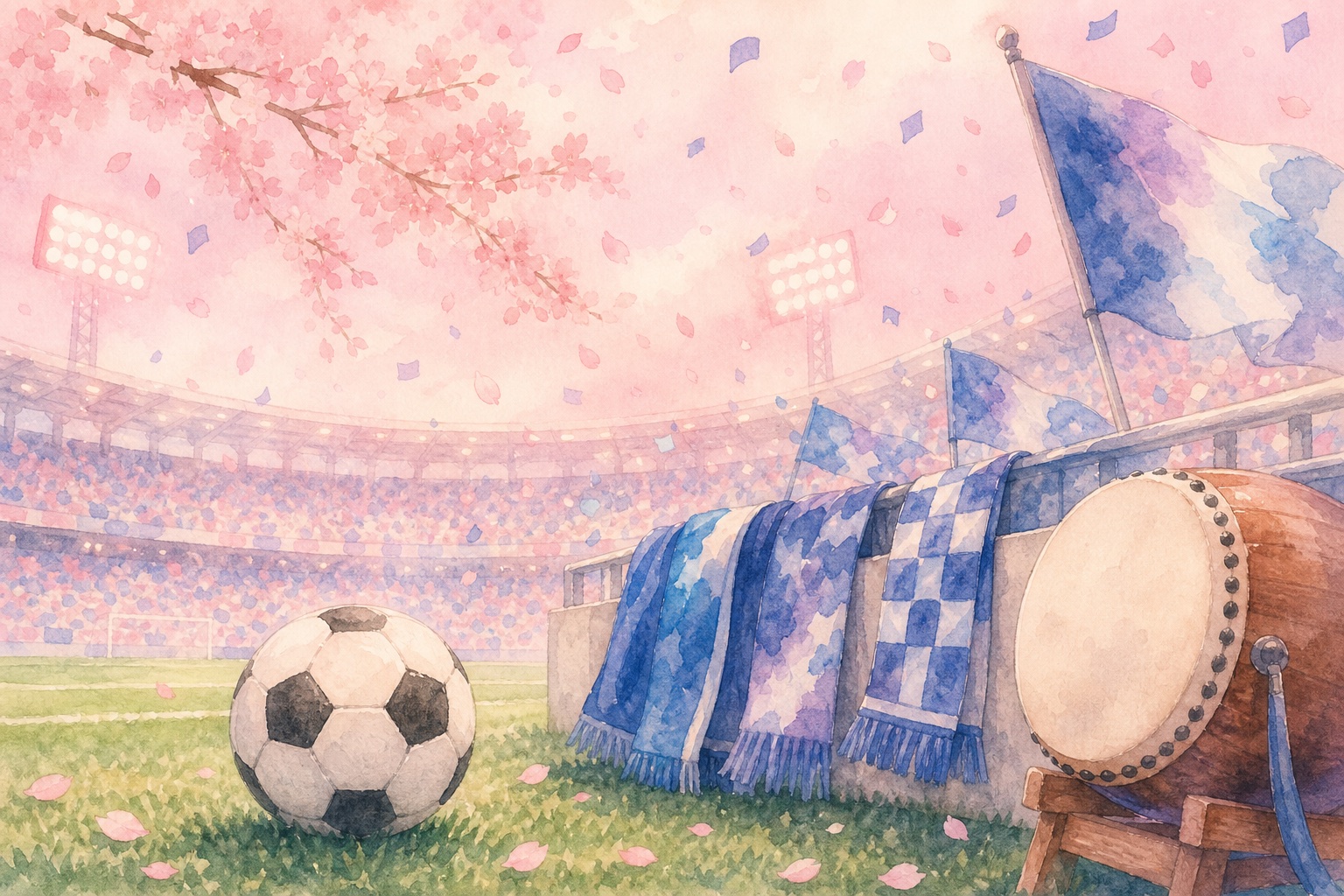
Anyone watching their first match in Japan is usually as impressed by the stands as by the pitch. Japanese supporter sections are highly organised: there are rehearsed chants for every player, drummers set the rhythm, and the singing often runs through the entire match regardless of the score. Three things stand out in particular.
- Organised chants: supporter groups rehearse songs and choreography, and each player often has a song of their own. The lyrics are simple, rhythmic Japanese, ideal for learning along.
- Drums and flags: big taiko drums structure the chants, giant flags wave for the entire match.
- The famous clean up: Japanese fans tidy their stands after the match with rubbish bags they brought along. At World Cups, Japanese fan sections regularly make headlines around the world for it.
Japanese players in the Bundesliga
For German football fans there is an especially nice bridge to Japan: the Bundesliga. Japanese professionals have been a fixture at German clubs for years, and in Japan, Bundesliga matches involving Japanese players are followed closely. For you that means there are plenty of Japanese interviews, reports and fan posts about players and clubs you already know. That overlap is exactly what makes the material so valuable for learning, because you understand the context before you understand the words.
Why football is a perfect immersion topic
The biggest enemy when learning with authentic material is overload: too many unknown words, too few anchors. Football solves this elegantly. You already know the rules, the flow and the drama of a match, so your brain only has to map the language, not the content. When the commentator screams after a shot hits the net, you know without a dictionary that a ゴール (gōru) was just scored. Add repetition: the same 30 words appear in every match report, and repetition in an emotional context is exactly what moves vocabulary into long term memory.
Football vocabulary to get you started
| Japanese | Romaji | Meaning |
|---|---|---|
| サッカー | sakkā | football |
| 試合 | shiai | match, game |
| ゴール | gōru | goal |
| 監督 | kantoku | manager, coach |
| 代表 | daihyō | national team |
| 応援 | ōen | cheering, support |
| 頑張れ | ganbare | Give it your all! |
| 勝つ | katsu | to win |
| 負ける | makeru | to lose |
And this is what it sounds like when you express your support in Japanese. This sentence works in the stadium, in conversation and as a comment under any match report.
Chants and interviews as listening material
So how do you turn this into real training? Two sources are especially rich. First, fan chants: they are short, rhythmic and repeat endlessly, like musical flashcards. Second, post match player interviews: they almost always follow the same pattern with the same set phrases, so after a few interviews you recognise the structure and can pick out individual new words deliberately.
- Watch the highlights of a match whose result you already know, with Japanese commentary.
- Listen to J.League club chants and read along with the lyrics. Many supporter groups publish their chant lyrics.
- Look up interviews with Japanese Bundesliga players in Japanese. You know the players, the clubs and often even the match being discussed.
- Learn the vocabulary from the table above actively, for example in a vocabulary trainer like the one in Sakuraflow, so you recognise the words when listening.
Frequently asked questions
Do I need a certain level to start with football Japanese?
No. Chants and the core vocabulary from the table work from day one. For interviews and match reports, N5 level basics help because you can recognise the sentence structure. The advantage of football: the familiar context carries you across many comprehension gaps.
What does the name Samurai Blue mean?
Samurai Blue (サムライブルー) is the official nickname of the Japanese men's national team. It combines the samurai as a symbol of fighting spirit and discipline with the blue of the shirts Japan has worn for decades.
Can I attend a J.League match as a tourist?
Yes, and it is very much worth it. Tickets are cheap compared to top European leagues and can be booked online. The atmosphere in the supporter section is family friendly and infectious, and you get 90 minutes of Japanese chants. A stadium visit doubles as one of the best language learning excursions Japan has to offer.
Japan's football culture is an experience in itself, and for you as a learner it is a gift: a topic you love, in a language you are learning. Start with the nine words from the table, find a match or an interview, and let football do the work. 頑張れ!
Related
Learn Japanese with Sakuraflow
Vocabulary, kanji, grammar and real exams from N5 to N1. The first week is free.
Start free