How to learn kanji: the method that actually works
Sakuraflow
Kanji are the final boss of learning Japanese, or so people say. That is only true if you approach them the wrong way. Anyone who tries to learn 2,000 characters by copying each one a hundred times is almost guaranteed to fail. Anyone who treats them as a system of building blocks instead learns them faster than they thought possible. This article shows you the method that self learners around the world have converged on: radicals, stories, frequency, context and spaced repetition.
Why rote copying fails
In Japanese primary schools, children copy each kanji dozens of times. It works for them, because they have six years, hear the language all day and already know the words before they learn the characters. You do not have those conditions. For adult learners, rote copying is the least efficient method there is: it trains the hand, not the memory. Two weeks later you fail to recognise a character you wrote fifty times. The problem is not your memory, it is that the character has no meaning attached that it could hold on to.
Radicals: the building blocks behind every kanji
The most important shift in perspective: kanji are not random piles of strokes, they are combinations of recurring building blocks called radicals. There are traditionally 214 of them, but the 50 most common are enough to get started, because they appear in the majority of all kanji. Once you know the building blocks, a new kanji no longer looks like fifteen strokes, it looks like two or three familiar parts.
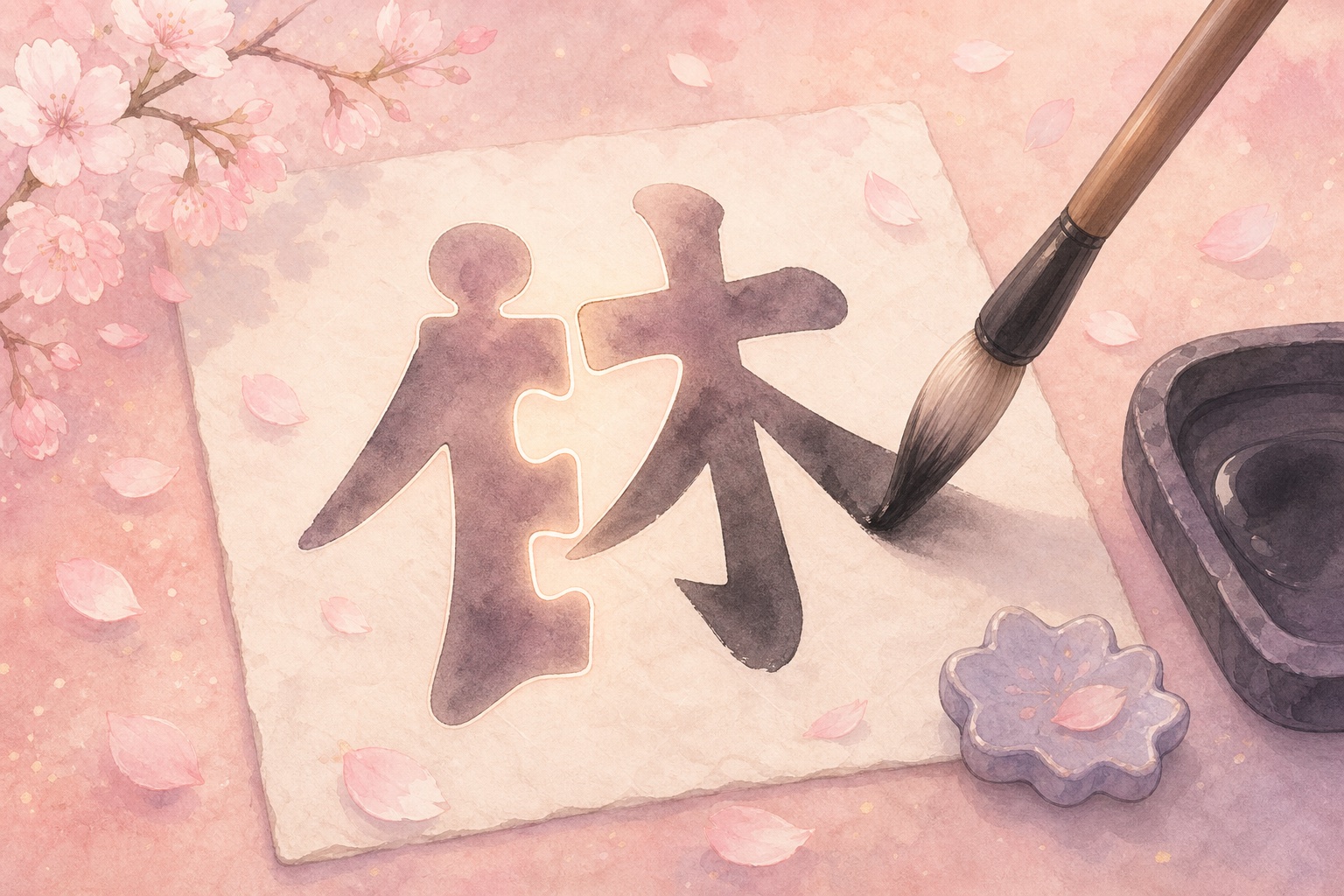
The classic example: the kanji 休 means "to rest". It consists of the radical for person (亻) and the kanji for tree (木). A person leaning against a tree, taking a rest. Once you have seen that image, you practically never forget 休 again. This exact principle works for thousands of kanji.
Mnemonics: the Heisig principle
The most famous kanji method is built on this idea: "Remembering the Kanji" by James Heisig, RTK for short. Heisig gives every building block a name and links the parts of each kanji into a little story. The more absurd the story, the better it sticks, because our brains remember images and emotions far more easily than abstract shapes. You do not need to work through the entire RTK book to benefit: you can apply the "building blocks plus story" principle to every new kanji yourself, and apps like WaniKani ship ready made mnemonics.
Frequency beats school order
Japanese pupils learn kanji in a fixed school order designed around what matters to children. For you as an adult learner, that order is suboptimal. Learn by frequency instead: the 500 most common kanji already cover the bulk of ordinary texts. Every frequent kanji you know makes real texts instantly more readable, and nothing motivates like being able to decipher something in the wild.
| Milestone | Number of kanji | What it means |
|---|---|---|
| JLPT N5 | approx. 100 | Simple signs, core vocabulary, first sentences |
| Primary school (kyōiku kanji) | 1,026 | Children's books, simple news, everyday texts |
| Jōyō kanji | 2,136 | Newspapers, novels, the official everyday repertoire |
Readings in context, not in lists
The second biggest mistake after rote copying: memorising readings in isolation. Many kanji have several readings, and 生 racks up more than ten. Trying to memorise a list of readings for each character means torturing yourself with abstract knowledge that does not help you read. Flip it around: learn vocabulary words that contain the kanji, and the readings come along for free. From 学生 (gakusei, student) and 生きる (ikiru, to live) you pick up two readings of 生 as a side effect, packaged inside words you need anyway.
Spaced repetition: the engine behind it all
Radicals and stories get kanji into your head, spaced repetition keeps them there. A spaced repetition system like Anki, WaniKani or the Sakuraflow vocabulary trainer shows you each kanji exactly when you are about to forget it: after one day, then three, then a week, then a month. That moves the knowledge into long term memory with minimal effort. Without such a system, you lose learned kanji almost as fast as you add new ones.
Your daily kanji plan
The final ingredient is the least spectacular one: consistency. Ten to twenty minutes every day beat any weekend marathon, because your brain needs repetition over time, not volume in one sitting. Here is what a realistic routine looks like.
- 1Reviews first: clear all due reviews in your spaced repetition system every day before starting anything new.
- 2Five to ten new kanji a day is plenty. Break each one into its building blocks and build a story from them.
- 3For every new kanji, learn two or three common words it appears in.
- 4Read texts at your level regularly. Every kanji you meet in real context sticks twice as well afterwards.
Frequently asked questions
How many kanji do I need to learn in total?
The official jōyō kanji comprise 2,136 characters, which is the repertoire for newspapers and everyday texts. To get started you need far fewer: around 100 for JLPT N5, about 300 for N4. With the 500 most common, you can already read most of an ordinary text.
Do I need to be able to write kanji by hand?
Not for most learning goals. In daily life you type Japanese, and the keyboard converts kana into kanji automatically. Recognising and reading is the core skill. Handwriting is worth it if you enjoy it or plan to study in Japan, but it is not a requirement.
How long does it take to learn 2,000 kanji?
At ten new kanji a day with consistent reviews, the maths says a good seven months, realistically one to two years with breaks. More important than speed is reading alongside, because that is what turns learned characters into readable words.
Should I learn all the radicals first?
No, that would be list learning all over again. Learn the 50 most common radicals, ideally together with the first simple kanji that contain them. You pick up the rest along the way as they show up in new kanji.
Kanji are not a mountain you have to climb in one push, they are a staircase with 2,000 small steps. With radicals, stories and a spaced repetition system you take a few every day, and a year from now you will look back and realise you can read. Start with your first ten today.
Related
Learn Japanese with Sakuraflow
Vocabulary, kanji, grammar and real exams from N5 to N1. The first week is free.
Start free